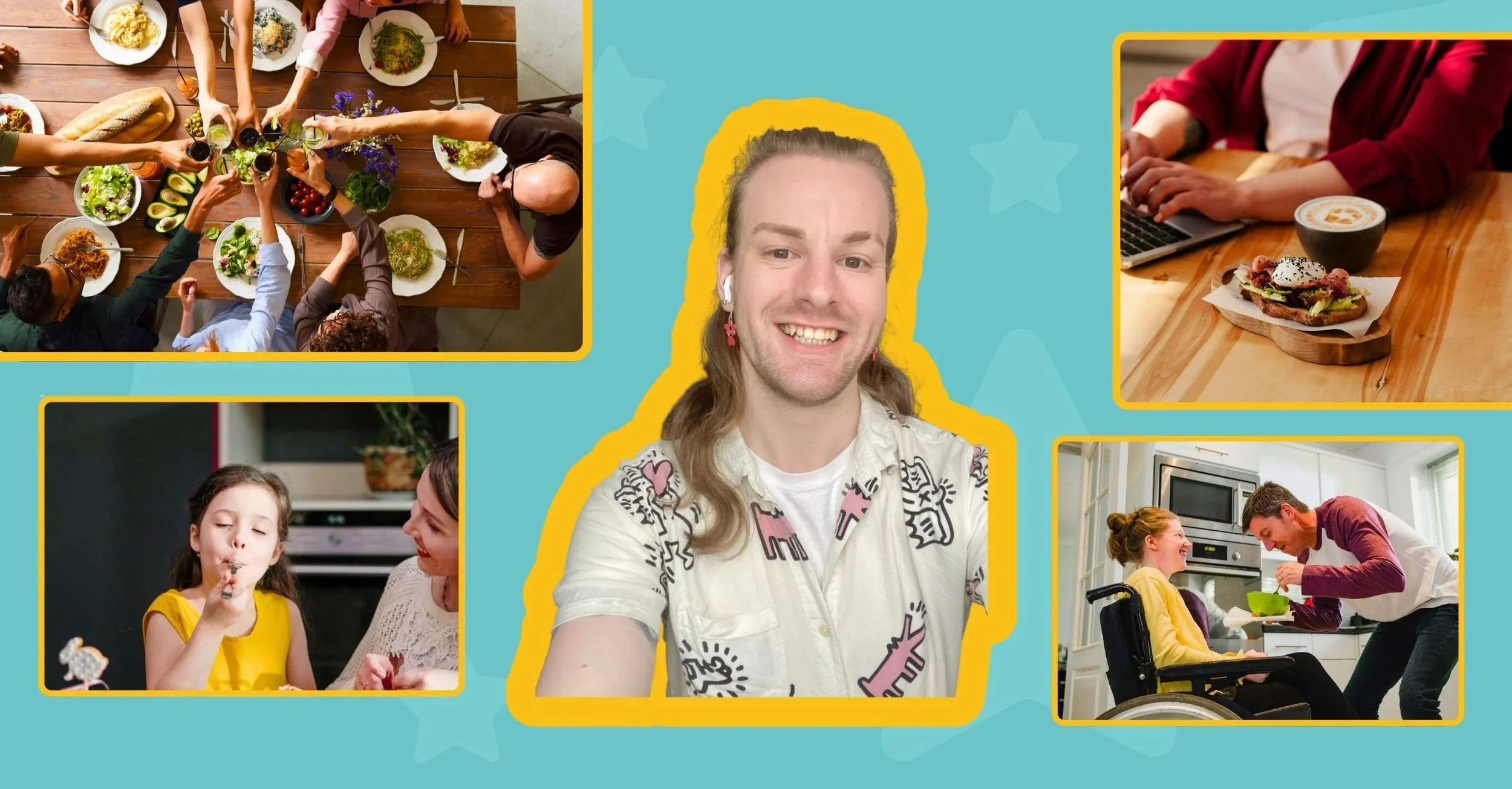
Written by: Caleb J, a Dysphagia-trained Senior Speech and Language Therapist on our Birmingham team shares insights into dysphagia, answering common questions and reflecting on what it means to support people with eating, drinking and swallowing difficulties.
Being a dysphagia therapist in our service
First and foremost, it’s very exciting being part of a rapidly growing service for dysphagia (eating, drinking and swallowing difficulties). It’s been amazing seeing our service, training, and knowledge adapt to match the communities we are working with. What’s become clear very quickly is that dysphagia is never just about food or drink. For many people, it affects social moments, independence, and the simple comfort of sharing a meal with others.
It’s been challenging adapting to brand new procedures and systems, but it’s rewarding to see them work well. There is always a level of trial and error when growing a service and reaching a new client group, but I’m so grateful to everyone who has given us feedback along the way. Witnessing the tireless work of my colleagues makes me grateful to be surrounded by a team who have a passion for what they do.
I love that we have a dysphagia team made up of people with every experience level. We can support each other, learn from each other, and signpost each other to external support when it’s needed.
It can be overwhelming to be reminded how broad and diverse dysphagia is. No two cases are the same, and no two clients are in the same situation. For many of the people we support, eating and drinking (something most of us do automatically every day) can become a source of anxiety, frustration, or even fear. Being able to help someone regain confidence or feel safer at mealtimes can make a meaningful difference to their daily life.
It has been a good reminder that multi-disciplinary support is often necessary to create the best outcomes — no professional is at their best when working alone. We’ve been very lucky to collaborate with some amazing professionals and organisations, and I look forward to what the future holds.
Caleb J., Senior Speech & Language Therapist at Magic Words Therapy in Birmingham
Three common questions about Dysphagia I’ve been asked recently:
“What’s the best treatment for dysphagia?”
There is no easy answer to this question. Every person presenting with dysphagia has an individual story, a unique set of challenges, and goals specific to them. There is no magical, cure-all treatment for dysphagia, as convenient as that might be. However, this doesn’t mean the situation is impossible. Rather, there is a large number of different approaches and strategies at our disposal. It’s important to remember there is a distinction between treatment, and management. Even if we can’t treat the dysphagia, there is a good chance it can be successfully managed so it’s not having such a large impact. Current research supports a large variety of support strategies, from simple postural changes to experimental bio-feedback systems.
A crucial part of the process is listening. This truly helps us to understand what matters most to the person and what a better outcome looks like, whether that’s safer swallowing, more enjoyable meals, or simply feeling less worried at the table.
“Can you live a long life with dysphagia?”
As a field, we are always innovating and researching new treatments. As our knowledge of dysphagia and its causes and complications grows, we are better able to accurately identify and treat it. What we do know is that the causes and presentation of dysphagia is so varied, meaning that every person has an individual experience. The best advice I can give is to find a team of professionals that take the time to learn about you as a person, your individual circumstances, and your goals for support. Having a team that knows you, and cares for your holistic wellbeing can often make the difference when managing dysphagia.
"What are the 4 stages of dysphagia?"
When you have an assessment or read a report, you may see that the summary is split into sections (or 'phases'). Depending on the professional, there may be 4 or 5 phases: pre-oral phase, oral preparatory phase, oral transfer stage, pharyngeal phase, and post-pharyngeal (or oesophageal) phase. These are not actually 'stages' of dysphagia! These refer to the process of a typical swallow:
First, we see, smell, and sometimes even touch the food
Second, we put the food into our mouth and chew it
Third, we move the food to the back of our mouth ready to move down our oesophagus
Fourth, we push the food down the back of our throat into the oesophagus
Finally, the food moves down our oesophagus into our stomach
These are useful for helping the professional identify where the problem is during the process of a swallow. One or more phases of the above process can be affected. It's important to remember that one phase being affected does not always mean the others will be as well.


Here at Magic Words Therapy, we are passionate about restoring safety, confidence & enjoyment around food and drink.
In closing
Mealtimes are often where some of our most meaningful moments happen — celebrations, conversations, and everyday connection. When swallowing becomes difficult, those moments can change in ways people don’t always expect.
At Magic Words, our dysphagia-trained therapists work with individuals and families to understand their experiences and find supportive strategies that help restore safety, confidence and enjoyment around food and drink.
If you are concerned for yourself or a loved one, please don't hesitate to reach out to our team or take a moment to read through our Dysphagia service page to learn more about our team of Dysphagia-trained therapists can support individuals of all ages with eating, drinking, and swallowing difficulties.
To begin the intake process, simply complete the form below. Once submitted, our team will send you a welcome pack along with information about booking your initial assessment.
If you’d prefer to speak with us first or have any questions before submitting the form, you can contact us on 01908 614 479 or by email at enquiries@magicwordstherapy.co.uk, and we’ll be happy to help.
Please note: In cases of emergency or if you / someone around you is choking, please call 999 immediately. Magic Words Therapy is not an emergency service.