Written by: Larisa Vaz (Speech & Language Therapist at our St Albans Clinic).

Keeping up with Speech & Language During The Christmas Holidays
Christmas is a wonderful, magical time of year for people of all ages. For some families, it can be an especially busy and overwhelming time, as well. For clients receiving ongoing speech and language therapy, the Christmas holidays often mean a break from regular sessions and it can be difficult to stick to routines and keep up with speech therapiy programmes at home. We put this blog together to help support you during this busy time of year - providing easy, low-prep holiday-themed activity prompts that tie to speech and language therapy goals / targets.
Making Christmas Cookies
From selecting ingredients to decorating the cookies, there are a number of opportunities to work on speech and language skills while you bake Christmas cookies for friends, family and loved ones:
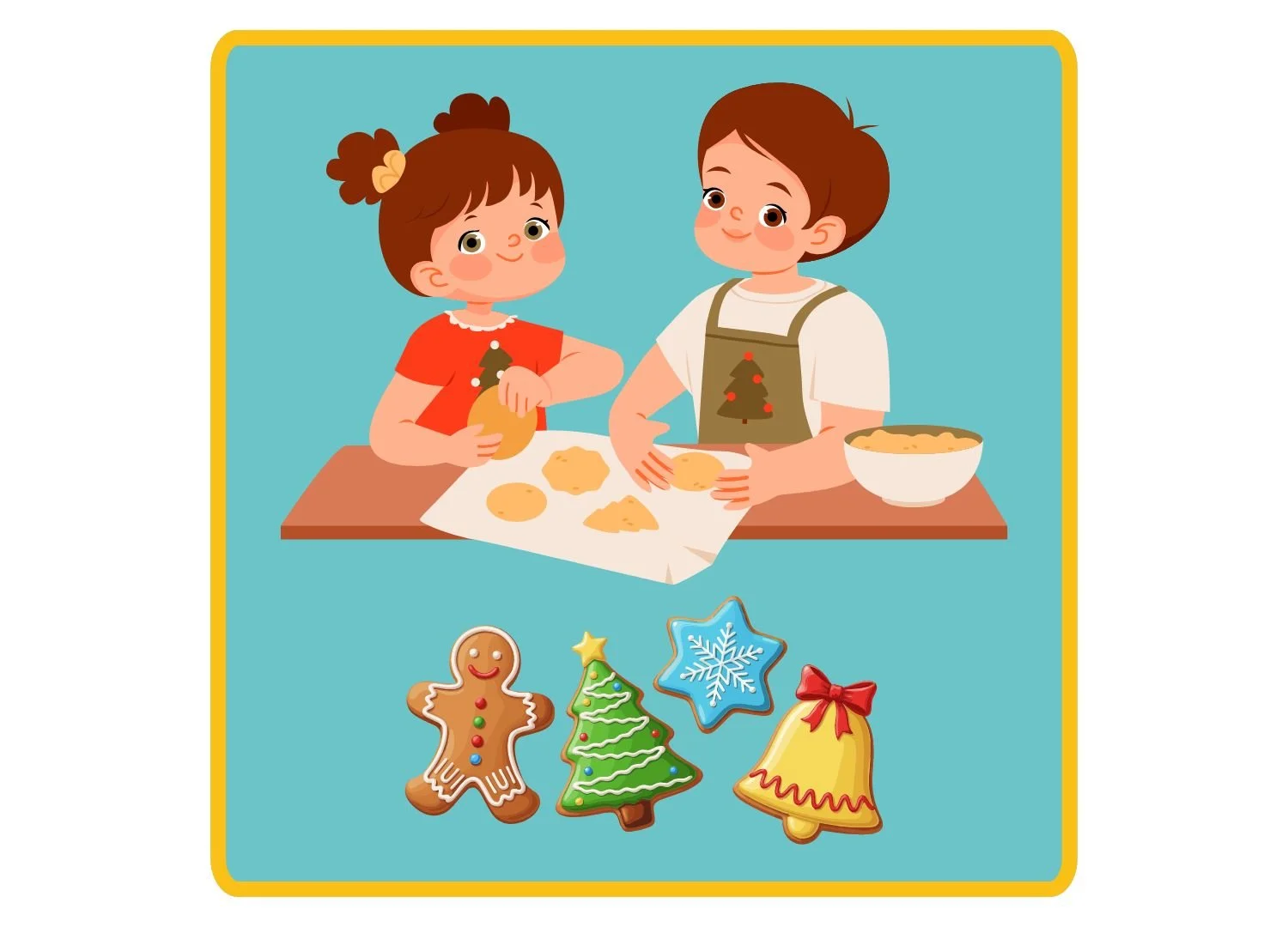
Vocab, Expressive Language, AAC: Model single words like ‘round’, ‘mix’, ‘help’, ‘cut’, ‘decorate’, etc. You can do this both verbally or by modelling using paper or powered AAC apps. Talk about the varying shapes of the cookies, how they taste (sweet, savoury) and the texture (soft, crunchy). You can also discuss the sizes and shapes of your cookie cutters (big vs. small, tree-shaped, star-shaped) and which colours they are (red, blue, etc.) If your child is already using single words and has learned to put two words together, model words like ‘round cookie’, ‘sugar next’, ‘mix flour’, ‘cut a big star’, etc.
Following instructions: Walk through simple instructions like “Cut a star”, “Get the butter” to more complex instructions such as: “Add two to three cups of flour and mix well”, “Decorate the big reindeer cookie with yellow and pink icing”.
Speech sounds: Consider the different sounds you might use when making the cookies. Consider words that may be repetitive such as ‘cookie’ in this instance and model them. This serves as a good opportunity for working on the /k/ sound.
Decorating the Christmas Tree
Decorating the Christmas tree is a beloved tradition that has been around for many years. Consider the following opportunities to work on speech and language:

Vocab, Expressive language, AAC: Model single words like ‘bauble’, ‘tinsel’, ‘decorate’, ‘star’, etc. Discuss the various types of baubles such as: ‘candy cane’, ‘angel’, and specific colours (red, blue, gold). If your child is already using single words and is learning to put two to three words together, model words like: ‘big star bauble’, ‘two baubles’, ‘sparkly Santa’, etc. Try using a wide range of descriptive language as this will help to support their vocab / development.
Following instructions: Walk them through following simple instructions “Hang the reindeer” and work up to more complex instructions “Hang the sparkly Santa next to the little pink candy cane”.
Speech sounds: Target different sounds that match the different types of baubles that you have. For example, you could say “Let’s sort all the baubles that are round like the /r/ sound” and work on practising the /r/ sound every time you pick up a bauble that matches this description.
Singing Christmas Songs
Listening to and singing along with Christmas songs plays an important role in the magic and wonder of the holiday season. Some popular favourites are:

Jingle Bells
Deck the Halls
Frosty the Snowman
O Christmas Tree
Santa Claus is coming to Town
The Twelve Days of Christmas
By singing along together, you create wonderful opportunities to build various speech, language and communication skills. For Gestalt Language Processors (GLP), you can use scripts or ‘gestalts’ to make Christmas more meaningful at various stages. For example, when singing the song ‘Santa Claus is Coming To Town’, model the following gestalts depending on which stage your child is at:
Stage 1: Use scripts or model ‘gestalts’ to communicate, for example “Santa Claus Is Coming To Town” while singing the song.
Stage 2: At this stage, break longer gestalts apart into smaller chunks (called ‘mitigation’) or mix and match scripts. For example, “Santa Claus” and “Is Coming To Town”.
Stage 3: Now, you can isolate single words and combine two words together, for example “Santa Come”
Stage 4: Here, you would model pre-sentence grammar in novel phrases, for example “Santa Come Home”
Stages 5-6: In these final stages, you can model early grammar in sentences, for example “I want to see Santa”. Then you can move onto more complex sentences and grammar. For example, “Should we leave milk and cookies out for Santa when he comes to visit tonight?”
Reading Christmas Stories

Pick out your family’s favourite festive books or traditional stories. While reading them together, discuss the pictures, predict what will happen next, and talk about the characters you meet along the way. A few Christmas classics you can choose from:
A Christmas Carol
How The Grinch Stole Christmas
Paddington & The Christmas Surprise
The Nutcracker
Stories are a brilliant way to tap into your child’s understanding skills. Use the Blanks levels of questioning with your favourite Christmas stories. For example, when reading ‘The Best Christmas Ever’ by Marni McGee and Gavin Scott, you can work on your child’s Blanks level targets:
Blanks 1: “Show me the mouse”, “What did you see there?”
Blanks 2: “Find something that you can eat”, “Name something here that is hot”
Blanks 3: “Name something here that cannot fly”, “What happened to the apple nut pie?”, “What does Christmas mean to you?”
Blanks 4: “Why could Felicity Finch and her chicks not find any food?”, “What can we use to make an apple pie?”, “Why did Millicent say that this was the best Christmas ever?”.
Most Christmas activities or day-to-day tasks / routines can be transformed into learning opportunities that give you the chance to work on speech and language goals and targets. If you need additional support during the holidays, check in with your assigned therapist for more specific advice on how to best support your child during the break!

Looking to start speech and language therapy sessions in the new year? We can help!
Book a free screening call to chat to a member of the team about our therapy and if it’s right for you. We aim to get in touch within a week.
To begin therapy, fill out the form below and we will be in touch with a welcome pack and more information about booking in your initial assessment.